How Much Does a House Cost? The Complete Guide to Home Buying in 2026
Real Estate Advice

How much does a house cost? This guide will help you think through the math of home ownership by looking at national averages, comparing the price tags of major U.S. cities, and breaking down how your own financial health helps determine what you can afford each month. Whether you’re a first-time homebuyer or you’re on property No. 5, understanding these variables is essential for ensuring you make a sustainable investment.
Buying a home is considered the largest financial milestone for many Americans, but it’s also a stressful and time-consuming process. Luckily, the market has now moved away from the harsh conditions of the early 2020s. While there has been a housing inventory increase in certain regions, average home prices still remain expensive. This makes it more important than ever to fully understand the total cost of homeownership, so let’s dive in!
How Much Does a House Cost? Looking at National and Regional Averages
While the national average home value sits at $360,600, home values vary significantly from city to city.
There has been a distinct split between the “Sun Belt” regions and the Northeast, along with parts of the Midwest. Construction has surged primarily in Southern states to meet demands, and home prices have started to dip. The Northeast and some Midwest areas remain expensive due to a lack of space for new builds and the “lock-in effect,” in which homeowners are reluctant to give up their low mortgage rates for significantly higher current market rates.
To give you a clearer picture of what might fall within your budget, here is a look at average home values in cities across the nation:
- San Antonio, TX (South): $247,100 — down 2.9% over the past year
- Jacksonville, FL (South): $282,400 — down 3.6% over the past year
- Denver, CO (West): $530,900 — down 4.3% over the past year
- San Francisco, CA (West): $1.3M — up 4% over the past year
- Chicago, IL (Midwest): $312,500 — up 2.5% over the past year
- Ann Arbor, MI (Midwest): $511,400 — up 3% over the past year
- New York City, NY (Northeast): $812,500 — up 3.5% over the past year
- Boston, MA (Northeast): $768,700 — down 0.4% over the past year
Understanding regional differences in the housing market is important not only because they dictate your mortgage, but also because they dictate your property taxes and insurance premiums. A $400,000 home in New Jersey can cost you significantly more per month than a $400,000 home in South Carolina simply because of the tax burden.
You can use resources like the National Association of Realtors and its quarterly economic forecasts to estimate month-to-month fluctuations in your target city.

How much does a house cost in real terms? The answer involves more than just the listing price.
The Income Equation
Determining how much a house costs is only a small part of the home-buying process, as the most critical aspect comes down to your income and how much you can afford per month. Rather than just looking at a general overview of your salary, lenders analyze your buying power, which is the relationship between your gross income and your existing debt. You should follow a few mathematical frameworks to stay financially healthy (and maximize your home affordability).
28/36 Rule
Most lenders and financial advisors recommend the 28/36 rule:
- The 28 percent: Your total monthly housing payment should not exceed 28 percent of your gross monthly income.
- The 36 percent: Your total debt-to-income (DTI) ratio, including your new mortgage, car loans, student loans, and credit card payments, should stay below 36 percent.
If you earn $100,000 annually, your maximum mortgage payment should be no more than about $2,333. If you’re managing another large payment, like a car note, it would be best to buy a cheaper house to keep your total debt monthly payments under $3,000 (36 percent).
3x Salary Rule
The 3x annual income rule is another financial guideline that states the price you buy a home for should be no more than three times your annual gross salary.
- How much money do you need to buy a 300k house? You should make an annual salary of at least $100,000.
- How much money do you need to buy a 500k house? You should make an annual salary of around $166,700.
If you choose to buy a home for a ratio as high as 4x or 5x above your annual salary, especially if your target area already has a high cost of living, this can leave you “house poor” — not the best position to be in when you consider having enough savings for travel, emergencies, and retirement.
Savings & Down Payments: The Psychological Hurdle
A key factor to consider when determining how much a house will cost you is the down payment. So, how much do you need for a down payment on a house? A 20 percent down payment used to be considered the standard. For example, on a $400,000 home, that percent would require $80,000 in cash. While putting 20 percent down is still ideal, it is definitely not the only path to homeownership.
According to the National Association of Realtors, the median down payment for first-time homebuyers is somewhere in the range of 10 to 19 percent.
Some government-backed programs allow for a significantly lower down payment, though:
- FHA Loans: If you have a FICO Score of at least 580 or higher, the minimum down payment for a house is 3.5 percent.
- VA Loans: A zero-down mortgage available for qualified veterans, active U.S. military members, and surviving spouses.
Credit Scores: The Interest Multiplier
It’s not just “How much does a house cost?,” but how much can you afford to spend on a house? Your credit score is the main factor that determines the amount of money you can actually borrow. Even if your score changes slightly, this can result in a massive difference in your monthly payment and the interest paid over the course of your loan.
Your credit score is used by a lender to assess risk. Those in the highest tier (781-850) will receive the lowest available interest rates. Here are some strategies to keep your credit in check and get the best deal on your loan:
- Check your reports: You can visit Annualcreditreport.com to make sure no errors are contributing to your score going down.
- Lower your utilization: Try to keep your credit card balances below 30 percent of your limits.
- Avoid new debt: Don’t open any new credit cards or take out large loans for at least six months leading up to your home purchase.

How much a house really costs goes beyond price — your choice of lender and loan can shape your monthly payment.
Loan Types: Conventional, Credit Unions, and Government
After you determine your credit score, it’s time to choose the right loan type for your mortgage. The institution and specific loan product you choose can significantly alter your monthly affordability, down payment, and how much you spend in interest over the term of the loan. How much does a house cost with a 30-year loan versus a 15-year loan? A lot more.
Conventional Banks vs. Credit Unions
Traditional commercial banks might be the most convenient option, but they typically have strict underwriting standards. Credit Unions, on the other hand, are non-profit entities that offer more competitive interest rates.
If a conventional loan still feels out of reach, government-sponsored programs, like FHA loans and VA loans, might be the best option. USDA loans are another option for low-income families living in rural areas.
Fixed-Rate vs. ARM
While the 30-year fixed-rate mortgage is the standard for stability, adjustable-rate mortgages (ARMs) secure lower initial interest rates and smaller monthly payments for the first three to 10 years. You’ll face the risk of your interest rate increasing later, but they’re a great option if you’re not looking to reside in a home long-term.
Maintenance & Operations: Hidden Costs of Buying a House
When most people calculate “How much does a house cost?” they don’t consider the hidden costs that can completely throw a budget. When it comes to renting vs. buying, the landlord covers repairs and other emergencies, but with buying, you are now responsible for those unexpected expenses.
1 Percent Maintenance Rule
The 1 percent maintenance rule suggests you set aside one percent of your home’s purchase price annually to account for routine maintenance and any repairs that will need to be done. So, if you own a $350,000 home, you should budget at least $3,500 per year. If you own a $600,000 home, you should budget at least $6,000 per year.
Property Taxes & Insurance Premiums
Insurance rates over the past few years have significantly spiked due to climate-related risks, inflation, and even rising construction costs. Premiums can vary by state, but most rates aren’t expected to drop anytime soon.
The HOA Factor
Of the pros and cons of an HOA, the biggest pro and con is possibly the homeowners' association (HOA) fees. HOA fees vary depending on your community, and some might pay $100 a month while others can expect to pay over $1,000 a month. While these fees don’t accrue interest over time, they are placed directly back into your neighborhood and might even end up paying for themselves. After all, a happy home equals a happy mind, right?
How Much Money Do You Need to Buy a House? — FAQs
Q: Is $10,000 enough to buy a home?
A: $10,000 could be enough to buy a home for first-time buyers using a low-down-payment loan.
Q: How much can I afford with $10,000 down?
A: A $10,000 down payment can afford a home priced between $285,000–$330,000 if you’re using a low-down-payment loan of 3 to 3.5 percent.
Q: Can I buy a house if I make $3,000 a month?
A: Yes, you can buy a house making $3,000 a month if you have manageable debt and good credit.
Q: How much money is needed to buy your first house?
A: The amount of money needed to buy your first house will depend significantly on location and loan type.
Finalizing Your Budget & Getting Started With the House Hunting Process
Determining how much a house will cost you will ultimately depend on your own financial fingerprint. You must align your income, credit score, and savings to find the right home that remains a blessing rather than a burden.
Before you visit a single open house, you can shop with confidence by doing the math now. You can use digital tools like the Zillow Affordability Calculator to input your own debt-to-income ratio, or the NerdWallet Mortgage Calculator to see how you could pay off your mortgage early.
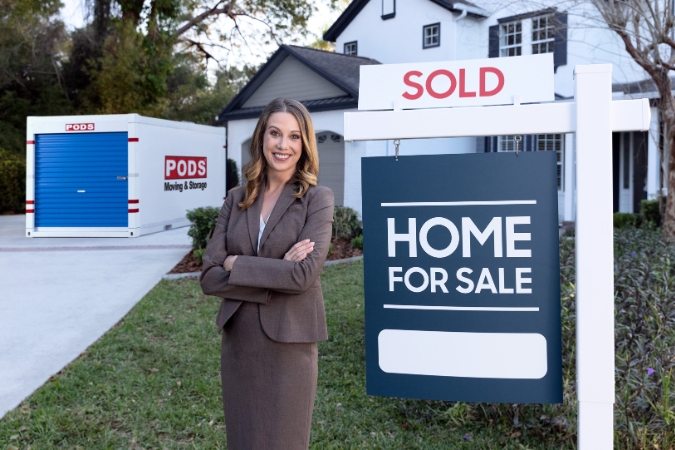
Make your move flexible with a PODS portable storage container delivered right to your driveway.
Make the Move to Your New Home With PODS
Make the move to your new home flexible with a portable moving container from PODS. Have the container delivered right to your driveway, where you can load it on your own schedule. PODS can even refer you to local packing and loading services if you need help with the heavy lifting. Once you’re ready to move, your container will be picked up and delivered right to your new home, or you can keep it in a secure PODS Storage Center until you’re ready for it.
Visit PODS online for a free local moving quote or call 877-350-7637 for long-distance moving.
Editor’s note: For ease of reading, monthly rental prices were rounded to the nearest $25 and home values were rounded to the nearest $100. Home values in the millions were rounded to the nearest $100,000.
*This article was written on behalf of PODS Enterprises, LLC (“PODS”). PODS does not warrant the completeness or accuracy of any information contained in this article and disclaims any liability for reliance upon the content herein.

Your quote in 60 seconds
Get pricing tailored to your needs!
Related Articles

Write an Offer Letter for a House in 6 Simple Steps and Say Hello Your Dream Home
Real Estate Advice
Read more